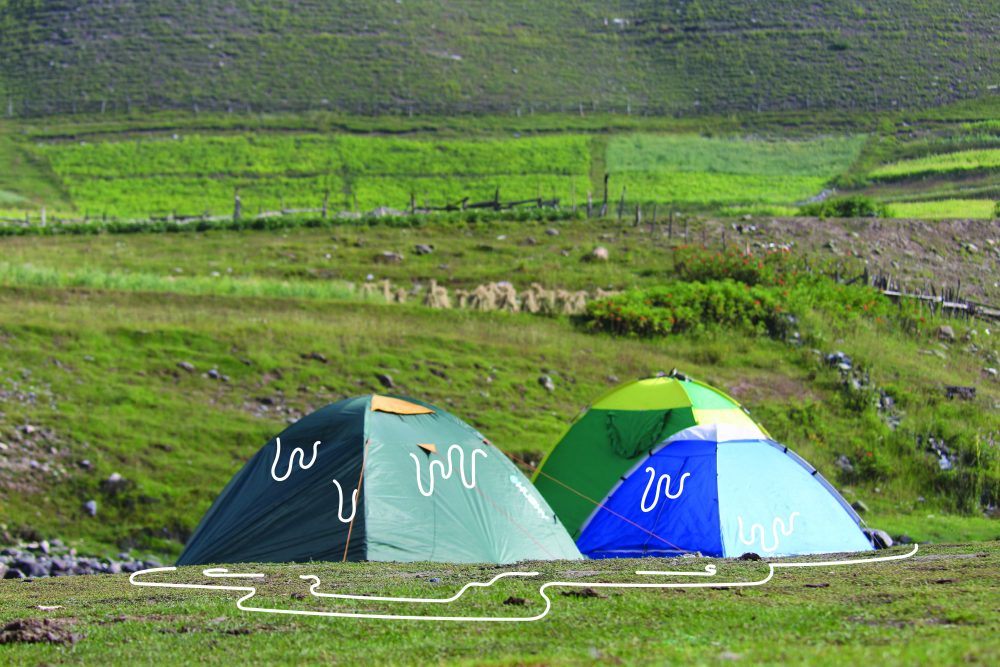
A festival tent has an unusual job. It has to go up quickly, in a field, possibly in the dark, possibly in the wind, be found again at 3am, and survive being lived in by people who are not at their most careful. Expedition-grade performance is not the point. Being easy, findable and adequately waterproof is.
What size tent do you actually need?
Tent capacities are optimistic. A two-person tent fits two people and nothing else, including their bags. The reliable rule for festivals is to add one to the number of people:
- One person: a two-person tent.
- Two people: a three or four-person tent.
- A group: two smaller tents beat one large one, because you can pitch them where there is space.
A porch or small vestibule is worth more than extra sleeping space. It is where muddy boots, wet coats and the bags live, and it keeps the sleeping area dry.
Waterproofing in plain English
Tent waterproofing is quoted as a hydrostatic head figure in millimetres. Anything from 2,000mm upwards is fine for a British summer. Higher is better but the number matters less than the taped seams and a sewn-in groundsheet, which is what actually stops water arriving from underneath.
Avoid the very cheapest supermarket tents if you can. They are not designed to be pitched twice, and the abandoned-tent problem at UK festivals is largely made of them.
Pop-up tents: honest assessment
They go up in seconds, which is their entire appeal, and it is a real one at midnight. The downsides are that they are usually less waterproof, catch the wind badly because of their shape, cannot be pitched taut, and folding them back down is a skill people learn from a video in a field while everyone watches. If you buy one, practise folding it in the garden first. Twice.
Where to pitch
Choosing the spot is more important than the tent itself.
- Go slightly uphill. Never pitch in a dip or a hollow. Water finds it, and so does everyone else's water.
- Not at the bottom of a slope, and not in the natural channel between two rises.
- Not next to the toilets, the main path, a generator or the arena wall. Twenty metres of extra walking buys hours of sleep.
- Look up. A tree gives shade but drips for hours after rain stops and drops branches in wind.
- Look for a landmark you can find at night from any direction. A flag on a pole works. So does memorising the row and the nearest water point.
Pitching so it survives
- Clear the ground of stones and anything sharp before you lay anything down.
- Pitch the door away from the prevailing wind, which in most of the UK means away from the south west.
- Peg out every guy line, even in still weather. Wind arrives at 4am, not at pitching time.
- Push pegs in at roughly 45 degrees, pointing away from the tent.
- Take spare pegs and a mallet. Festival ground is either baked hard or soft enough to lose a peg entirely.
- Leave a vent open. Most tents that seem to be leaking are actually full of condensation.
- If the ground is soaked, an extra groundsheet or tarpaulin inside the tent under your mat adds a useful layer.
Finding it again
Drop a pin on your phone map as soon as it is up. Then set up something visible that is not a flag identical to the fifty other flags: a distinctive colour, an odd object, a shape. Tell everyone in your group the landmark and the row.
Taking it home
Take the tent home. A tent left behind is not donated to anyone, it is waste, and clearing them costs festivals a substantial amount every year. Dry it out properly within a day or two of getting back, because a tent packed away damp will be mouldy and unusable by next summer.
Frequently asked questions
How waterproof does a festival tent need to be?
A hydrostatic head of 2,000mm or above, with taped seams and a sewn-in groundsheet, is enough for a UK summer.
Are pop-up tents allowed at festivals?
Yes, at general camping. Gazebos are the item more commonly banned, so check the festival's prohibited list.
Should I pitch on a slope?
A very slight slope is ideal, sleeping with your head at the top. A hollow is the worst choice on any site.
How do I stop my tent leaking?
Most apparent leaks are condensation. Ventilate, avoid touching the inner wall from inside, and check the seams and groundsheet before you travel.