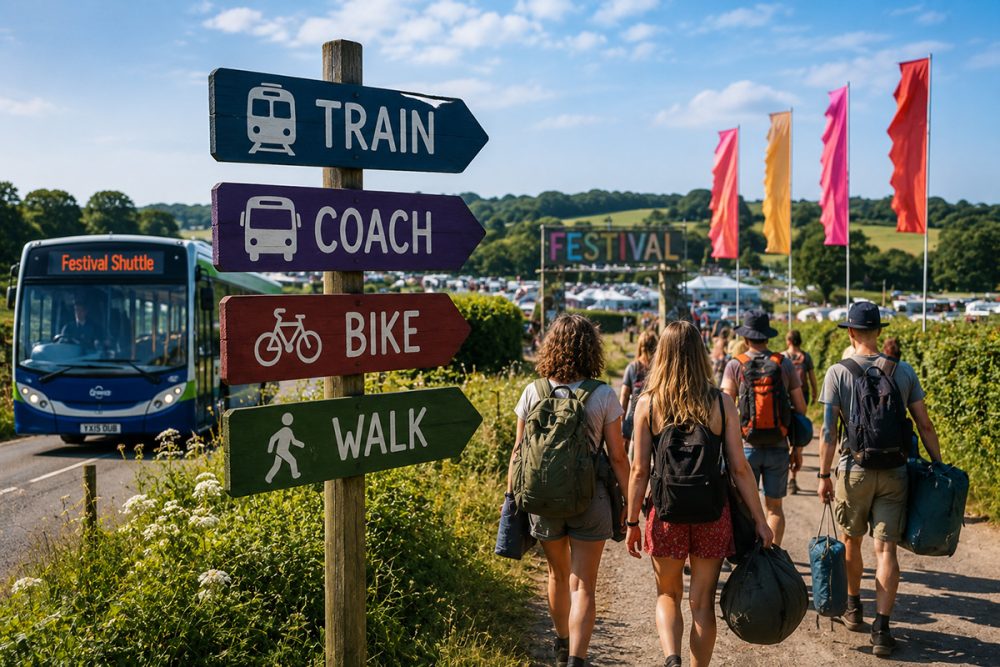
The short answer: the official festival coach is usually the easiest and cheapest option, because it drops you at the gate and your ticket is tied to it. Train plus the festival's shuttle bus is the next best. Book both as early as you can, because coach places and shuttle capacity sell out well before the festival does.
Most UK festivals are held on farmland precisely because there is nothing else there, which makes public transport a genuine challenge. Here are the realistic options.
Official festival coaches
Almost every large UK festival runs its own coach network, typically operated by a dedicated travel partner, picking up from dozens of cities and towns.
Why it's usually the best choice:
- It drops you inside the site or at a dedicated coach gate, which is often much closer to the campsites than the car parks.
- Coach travellers frequently get early entry or a dedicated queue.
- Prices are typically £30–£80 return depending on distance – cheaper than a train and far cheaper than fuel plus parking for one person.
- Your seat is reserved both ways, so the journey home is guaranteed.
The catches: you must book early, the return journey leaves at a fixed time on a fixed day, and luggage allowance is limited – usually one bag plus a tent, which rules out a trolley and a gazebo.
Train plus shuttle bus
Most festivals publish a nearest station and run shuttle buses from it. This works well if the station is on a main line from where you live.
- Book train tickets the moment advance fares are released, usually around twelve weeks out. Festival weekends see huge demand on the relevant routes.
- Buy shuttle tickets in advance from the festival site. On-the-day tickets sell out and the queue is long.
- Check engineering works. Summer weekends are when Network Rail does its major work, and a rail replacement bus with a rucksack and a tent is a bleak experience.
- Check the last shuttle for your journey home, particularly on the Monday.
A railcard is worth having if you go to more than one festival a year – the 16–25, 26–30, Two Together and Network cards all pay for themselves quickly.
National coach services
National Express and Megabus serve most large towns cheaply, and are often the lowest-cost option of all if you're flexible on timing. The disadvantage is that they drop you in a town centre, so you still need the shuttle or a taxi for the final leg. Journey times are long, so factor in arriving tired.
Lift shares
Most festivals have an official lift share page or a large Facebook group where people offer spare seats. It's cheap, sociable and gets you door to door.
Sensible precautions apply: use the festival's official group or platform rather than an open marketplace, agree the cost of fuel in advance, share the plan with someone at home, and don't rely on a lift share for your journey home without a backup, because plans change on the Sunday of a festival.
Taxis and ride-hailing
Useful for the last few miles from a station, but treat them as a backup rather than a plan. Rural coverage is thin, ride-hailing apps often have no drivers in the area, phone signal near the site is unreliable and surge pricing at chucking-out time is severe. If you're going to need one, book a local firm by phone in advance and take their number written down.
Cycling and walking in
A growing number of UK festivals have secure bike parking and some offer a small discount or a dedicated entrance for cyclists. It only works if you live locally or can get a bike to a nearby station, and it obviously limits what you can carry, but for a light-packing day visitor it can be the fastest way in and out.
Packing when you're not driving
This is the real constraint. Without a car boot you have to carry everything, in one go, possibly on a train.
- Rucksack, not a holdall. Hands free, weight on your hips.
- Buy a small, light tent. A two-person tent weighing 2–3kg makes the whole trip viable.
- Split communal kit with whoever you're meeting there.
- Skip the chair or buy a lightweight folding stool.
- Buy food and drink near the site, not at home. Many festivals have a supermarket within a shuttle ride, and several run their own on-site shop.
- Take a folding bag-for-life for the shop run.
Getting home
Plan the return journey before you go, and write it down somewhere that isn't your phone. Sunday night and Monday morning departures are chaotic, phones are dead, and the shuttle queue can be an hour. Set an alarm for a realistic departure time and agree it with your group on the Saturday, not the Monday.
Frequently asked questions
When should I book festival coach travel?
As soon as it goes on sale, usually at the same time as or shortly after tickets. Popular pickup points sell out months ahead.
Is the festival shuttle bus included in my ticket?
Rarely. It is usually a separate paid ticket, though a few festivals include it.
Can I take a trolley on a coach?
Generally no. Coach luggage allowances are limited to a bag and a tent per person.
What if I miss my return coach?
You'll need to make your own way home at your own cost, so build in more time than you think you need on the final morning.